My writing routine is boring but effective. Every day I wake up at 6am, make a cup of tea, write until about 8am, and then get ready for my day job. Progress can feel slow at times, especially when working on a long story, but mostly I’m just happy I get to write fiction at all.
Writing
I am currently in the midst of my largest novel to date, an historical horror fantasy. At just over half-way through, the first draft is a pinch under 100,000 words. I imagine a good portion of that will end up in the bin during editing. Still, it is an achievement considering my last project The Mermaid was less than 40,000 words, and the one before that (a trunk novel) ended up at around the 80,000 word mark.
Life
It’s October already, my favourite month of the year. The smell of burning leaves in the air. Starlit nights. Horror movies on the TV. That’s the stuff.
In September I visited Berry Pomeroy Castle, supposedly one of the most haunted castles in Britain. The ghosts stayed well hidden, but I was lucky enough to see a specialist from the Wimborne Militia fire an authentic 17th century musket. The noise just from that one gun was incredible. Much louder than a firework. The cacophony of an entire unit of musketeers firing at once must have been deafening. I certainly don’t envy those poor pawns of history, slogging through miles of mud and gore just to blow out their own eardrums and choke on gunpowder smoke.
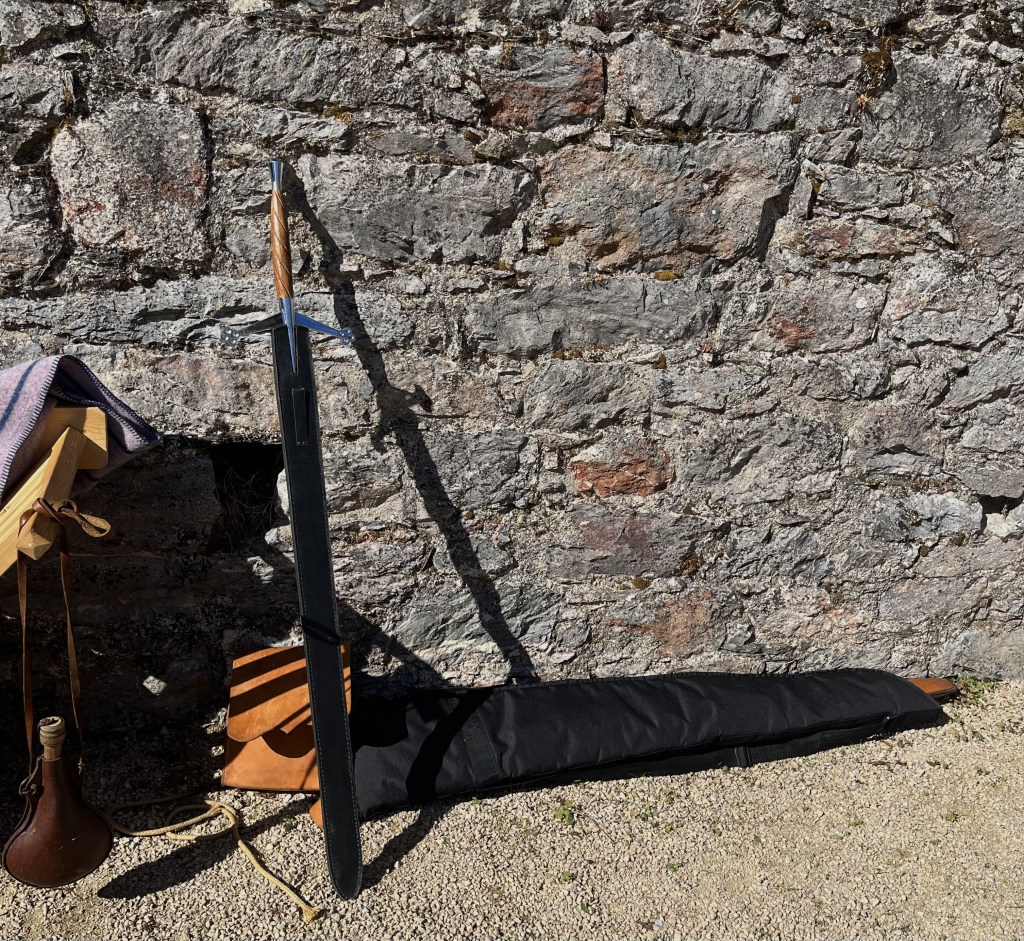
The guy from the militia also had some swords with him, including a medieval-style longsword. I snapped a picture for my growing catalogue of research, just in case I ever get around to writing an epic fantasy.
A longsword propped against the wall at Berry Pomeroy Castle
Plans
for the month is 120k words. I’ve got a few other commitments coming up, though, so progress might be hampered a bit. Time will tell.
If you’re working on a creative project at the moment, remember to be kind to yourself. And ask questions of the world around you. Inspiration can be found everywhere, even in the most unlikely places.
I’ve been working on a new novel for the past few months. Currently I’d say I’m somewhere between one third and half way through the first draft, though it can be difficult to tell.
I know many authors plan their novels meticulously before sitting down to write the first draft. Personally I find that method can drain my excitement for the story. If I plan too thoroughly before I begin, then I feel as though I’ve already told the story. I get bored, and move on to my next idea.
My personal system for planning stories is a bit loose, but goes something like this:
Initial idea / spark of inspiration. This is often a single sentence describing a character, setting or plot point. I’ll jot this down in my ideas notebook.
Interrogate the idea. Come up with four or five bullet points for the plot and characters. Figure out the core conflict that drives the story forward. Importantly, this stage also involves coming up with an ending. If I do not know the ending of the story, then there is no point in trying to write it. Some ideas fail at this hurdle and I scrap them.
Research and development. This includes research, world building, character development, and a more detailed plot structure. Not many ideas fail at this stage, but some get put on hold for long periods while I work on others.
By the time this is over, I’ll normally have a page or two of bullet points that outline all of the key plot points, and maybe another page or two of bullet points about the main characters and setting. This is the prefect stage for me to dive in and start writing the first draft. I know just enough to write the story, but not so much that I am bored of it, or start to doubt its robustness.
Writing the first draft can take a long time. For a short novel it takes about 3 or 4 months. Longer novels can take six months, or even a year.
When I began the novel I’m currently writing, I thought it would end up at about average length. It has already become clear that is not going to be the case. I’m just reaching the end of the first part of the story, and the draft is already the length of a short novel.
Many of those words will be deleted or revised in editing. But assuming the draft continues at this pace, it could easily end up being the longest I have ever written. I was hoping to have the entire draft finished by the end of August, but now I suspect it will be the end of the year. Perhaps even the start of next year, depending how life goes.
While it is frustrating when the first draft takes longer than expected, in some ways I’m quite happy about it. Until now I’ve always had more trouble with my stories being too short than too long. It’s nice to have the opposite problem for a change.
I’ve been writing fiction for my entire life. I was hooked at about five or six years old, when I first encountered The Hobbit. Ever since then, one way or another, I’ve been reading and writing fantasy, sci-fi, and horror.
In my twenties I studied writing at university and wound up with a master’s degree in professional writing. Yes, that makes me a fully qualified novelist, editor and screenwriter. No, I’m not sure exactly what that means.
It’s been a long time since then, and I’ve learned even more since graduating. University writing courses tend to focus on writing craft. That’s great. You need to learn at least the fundamentals of craft in order to be a novelist or screenwriter. But in my experience, excelling at writing craft is not necessarily the most important aspect of actually being a writer.
Don’t get me wrong, craft clearly matters. But the simple act of sitting at your laptop, day after day, and getting the words down is often far more vital.
After all, you could be the most gifted writer in the world, but if you only produce a couple of pages a year, you’re never going to finish a novel. A workmanlike, consistent writer will always get there first, and likely have a better shot at a writing career, too.
Because there’s only one definition of a writer that matters. Writers write.
Taken seriously, novel writing is a solitary and time-consuming activity. It’s one of the most demanding art forms out there, requiring constant practice just to maintain your voice, let alone improve upon it.
You should take time off now and again, of course. But for every day you do, you can bet it will be that bit harder to pick up where you left off. What’s more, most people are writing around other responsibilities: day jobs, family life, health conditions, education. How on earth are you supposed to find the time, let alone the energy, to commit to writing every day?
After I graduated from university, this was something I struggled with for years. I couldn’t figure out how I was supposed to write. Not how to write well, but how to physically find the time and space to just sit down and type the words.
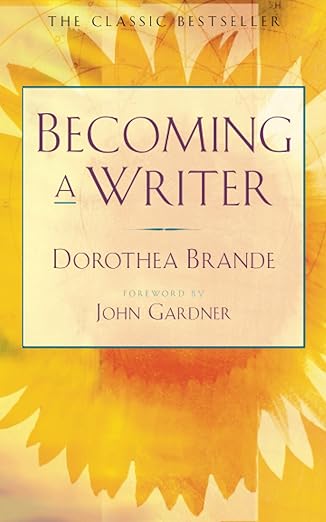
Becoming a Writer by Dorothea Brande
That’s where this fantastic book comes in: Becoming a Writer by Dorothea Brande. These days, I honestly believe most aspiring writers will benefit more from reading Brande than Vogler or Strunk. It’s the first book I would recommend to anyone who wants to take writing more seriously.
In Becoming a Writer, Brande outlines the four key difficulties many writers face: struggling to get started, inability to continue after early success, inconsistency of output, and loss of momentum partway through a project.
She has one solution for all of these problems. Developing the workmanlike mindset of a professional writer by carefully balancing the creative impulse with discipline, routine, and prioritisation.
One particular piece of advice in Becoming a Writer turned me into a better writer almost overnight. In chapter five, Brande discusses the benefits of getting up in the morning and writing before you do anything else. Don’t read the news, don’t eat breakfast, don’t get dressed. Just get up and write, before your brain has a chance to get in the way.
Like many writers, I had always considered myself something of a night owl. But I decided to give it a go. Mostly out of desperation.
It worked like a charm. Not only was I able to write more quickly in the mornings, but I was in a better mood for the rest of the day, too. Writing no longer felt like something I wanted to do that was getting delayed by other tasks. Instead, I was prioritising writing above everything else. I no longer had to feel frustrated all day, waiting for my opportunity to write.
It must be two or three years now since I took this advice from Dorothea Brande. Today, my routine is still the same. I get up at an ungodly hour in the morning, before anyone else is awake. I make a cup of tea and sit down at the table in my living room with my laptop. I open my laptop, and write for an hour and a half. When that time is up, I save my work, make a coffee, and get ready for the day ahead.